April 15, 2026
Stumbras marks 120 years – from a Kaunas spirits warehouse to a global brand
A symbolic year – when brothers Orville and Wilbur Wright secured the “Flying Machine” patent, and physicists were grappling with Albert Einstein’s newly published energy equation. In Kaunas, 1906 also marked the beginning of the Stumbras distillery – a milestone that shaped the future of Lithuania’s beverage industry and its traditions. Over 120 years, the factory has lived through the Tsarist regime, interwar Lithuania, the Soviet era, and ultimately a return to independence – when Lithuanian business opened up to the wider world.
“Every brick here seems to tell a story. As you step onto the factory grounds, you feel a deep respect for the past and the continuity of traditions that our team carries forward today,” says Vaida Paulikė, Production Director at Stumbras. “It’s remarkable how much about a city and a country can be revealed through a single name.”
One of Kaunas’ oldest industrial companies has undergone many transformations, yet has remained a leader in its field – driven by a commitment to innovation and high technological standards.
According to V. Paulikė, not only have technologies and production volumes evolved over 120 years, but the role of the factory itself has shifted – from part of a state monopoly to a private business confidently expanding into international markets and promoting Lithuanian products worldwide.
Always in the heart of Kaunas
At the end of the 19th century, when a state vodka monopoly was introduced in the Russian Empire, only state-owned factories were allowed to produce and sell spirits. One such facility was built in Kaunas in 1906, near the railway station, initially named simply Kaunas Spirits Warehouse No. 1.
Back then, production and sales were measured not in liters, but in buckets – according to the measurement system of the time. One bucket equaled around 12.3 liters, and quantities as small as 1/200 of a bucket could be purchased. Annual turnover reached 150,000 buckets – a significant production scale for the era.
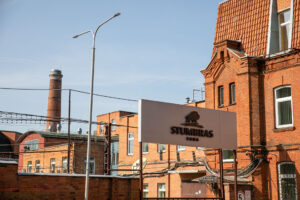
The factory complex, located between what are now Bažnyčios and Girstupio streets, remains one of the most prominent symbols of Kaunas’ industrial heritage. While the city has transformed beyond recognition over 120 years, Stumbras has preserved its authenticity – century-old red brick buildings and the original spatial layout instantly transport visitors back in time. Today, it is not only a functioning factory, but also an architectural and historical part of Kaunas’ identity.
The only museum of its kind in Lithuania
Not every Kaunas resident may know that the red brick complex is also home to the unique Stumbras Museum, opened in 2009. It is the only museum of its kind in Lithuania, offering visitors a chance to explore archival materials, historic packaging, production equipment, and other exhibits – providing insight not only into the factory’s evolution, but also into the broader history of Lithuanian industry.
According to Vidmantė Mickevičienė, Head of Visitor Centers at MV GROUP Production, the museum serves more than an educational purpose. The factory spaces have also opened up to art and culture – something highly valued by contemporary artists seeking distinctive contexts for their work. The authentic industrial setting adds layers of meaning to creative projects and offers audiences a fresh perspective on art.
In recent years, the factory has hosted theatre performances, music concerts, and, most notably, the 15th Kaunas Biennial – an international contemporary art exhibition featuring artists from around the world.
Mickevičienė adds that the anniversary year will also be rich in events, including the Stumbras Bartenders’ Championship and an open day at the museum with free guided tours.
Driven by the will to win
Algirdas Čiburys, CEO of MV GROUP Production, notes that while the company has seen many changes over its 120-year history, its people remain the strongest link between past and future.
“The latest transformation began over 20 years ago, when the ownership of the factory changed. The acquisition of the Kaunas plant in 2003 was the largest deal in the company’s history – a major investment and a strategic shift toward manufacturing and proprietary brands,” he explains.
Today, that journey is best reflected in the fact that vodka produced in Kaunas is included in Drinks International’s prestigious The Millionaires’ Club ranking.
Long-standing traditions and high quality have earned Stumbras brands numerous awards. Lithuanian vodka “Lithuanian” is the most awarded vodka produced in the country, with a total of 109 accolades across the product line – including 64 awards for “Lithuanian Gold.”
Expanding in international markets
The Kaunas factory currently employs 80 people, most of whom have been with the company for over a decade. According to Čiburys, Stumbras works in close synergy with other MV GROUP Production teams – including Alita, Anykščių vynas, and Gubernija – sharing knowledge, ideas, and expertise.
He notes that the modern Lithuanian beverage manufacturing business was essentially built starting from Stumbras – and the company continues to evolve.
“We are developing the brands nurtured in Kaunas in two directions – maintaining and expanding our strong spirits portfolio, while actively entering the lower-alcohol and ready-to-drink cocktail segment. These shifts are driven by market trends and our ambitions for long-term international growth, with particular focus on the Baltic states and Poland,” Čiburys concludes.
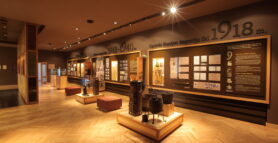
“Stumbras” factory museum opens its doors – experience 120 years of history firsthand
April 29, 2026
Some places don’t just tell history—they let you experience it. One of them is the “Stumbras” factory museum in Kaunas.
Read more...
Stumbras marks 120 years – from a Kaunas spirits warehouse to a global brand
April 15, 2026
A symbolic year – when brothers Orville and Wilbur Wright secured the “Flying Machine” patent, and physicists were grappling with Albert Einstein’s newly published energy equation.
Read more...
Kaunas biennial to take place for two months in the historic Stumbras factory spaces: inviting audiences to discover art
September 9, 2025
Every two years, the Kaunas Biennial attracts outstanding Lithuanian and international artists, and this year it will also be hosted in the historic Stumbras factory spaces. The industrial site, with almost 120 years of history, once again opens its doors to art and culture. On September 12, the 15th edition of Lithuania’s largest contemporary art festival will open there with the exhibition Life After Life, which will run for two months.
“Renowned artists from around the world note that our factory is a unique and undiscovered industrial space. The environment gives creativity new layers of meaning and allows audiences to experience art from different perspectives. Here, not only space but also time becomes significant –the production halls have their own rhythm and visiting hours. We hope that during the two months of the Biennial, Kaunas residents and city guests will discover unique experiences here,” says Vidmantė Mickevičienė, Head of Visitor Centers at MV GROUP Production.
 According to Kaunas Biennial director Neringa Kulik, the Stumbras factory is one of the most prominent symbols of Kaunas’s industrial heritage, and its history vividly illustrates processes of transformation. “Today, by hosting the 15th Kaunas Biennial exhibition, the factory becomes a living example of how industrial memory and history can create fertile ground for dialogue with contemporary art,” the curator shares.
 Space as meaning
Kulik emphasizes that one of the Biennial’s main supporters has engaged in the project in a truly multifaceted way. Each building on the factory grounds carries its own story and conveys powerful meanings, making the presentation of works in these historic spaces both a challenge and an opportunity. According to her, artists will enter the site with fresh reflections and immerse themselves in dialogue.
“When choosing Biennial locations, we sought places with a strong historical, cultural, or architectural narrative. Stumbras offered a unique context where industrial heritage, collective memory, and ongoing transformation intertwine. In such a setting, contemporary artworks gain an additional layer of meaning—they are not only displayed but also resonate with the space itself,” Kulik notes.
Meanwhile, Mickevičienė points out that visitors will be able to join special tours and combined excursions, where they will explore both the Biennial’s main exhibition and the Stumbras museum, founded in 2009. Various creative workshops will also be held – Kaunas Biennial consistently prioritizes accessibility and openness, ensuring visitors feel welcome in the contemporary art space.
Anticipating stars of contemporary art
The organizers highlight the legendary British artist John Smith as the Biennial’s brightest star. His work reflects on his artistic legacy, his experience with cancer, and his relationship with the present moment.
During the opening event on September 12 in the Stumbras spaces, well-known Lithuanian musician and performance artist Paulius Janušonis will perform, along with the London-based collective Rat Section. A live concert at Kaunas Artists’ House will feature Jasper Marsalis – the heir of the famous jazz dynasty, son of Wynton Marsalis and grandson of Ellis Marsalis.
In addition, visitors will encounter works by other internationally recognized artists, including Alex Mackin Dolan, Cudelice Brazelton IV, Phung-Tien Phan, Niklas Taleb, Max Göran, and more.
Space as meaning
Kulik emphasizes that one of the Biennial’s main supporters has engaged in the project in a truly multifaceted way. Each building on the factory grounds carries its own story and conveys powerful meanings, making the presentation of works in these historic spaces both a challenge and an opportunity. According to her, artists will enter the site with fresh reflections and immerse themselves in dialogue.
“When choosing Biennial locations, we sought places with a strong historical, cultural, or architectural narrative. Stumbras offered a unique context where industrial heritage, collective memory, and ongoing transformation intertwine. In such a setting, contemporary artworks gain an additional layer of meaning—they are not only displayed but also resonate with the space itself,” Kulik notes.
Meanwhile, Mickevičienė points out that visitors will be able to join special tours and combined excursions, where they will explore both the Biennial’s main exhibition and the Stumbras museum, founded in 2009. Various creative workshops will also be held – Kaunas Biennial consistently prioritizes accessibility and openness, ensuring visitors feel welcome in the contemporary art space.
Anticipating stars of contemporary art
The organizers highlight the legendary British artist John Smith as the Biennial’s brightest star. His work reflects on his artistic legacy, his experience with cancer, and his relationship with the present moment.
During the opening event on September 12 in the Stumbras spaces, well-known Lithuanian musician and performance artist Paulius Janušonis will perform, along with the London-based collective Rat Section. A live concert at Kaunas Artists’ House will feature Jasper Marsalis – the heir of the famous jazz dynasty, son of Wynton Marsalis and grandson of Ellis Marsalis.
In addition, visitors will encounter works by other internationally recognized artists, including Alex Mackin Dolan, Cudelice Brazelton IV, Phung-Tien Phan, Niklas Taleb, Max Göran, and more.
 The factory as an active participant in change
According to Mickevičienė, the Stumbras factory is an inseparable part of Kaunas’s life – a living space where not only industry grows. “We became partners and supporters of the Biennial because we want to show how for nearly 120 years we’ve been making history, integrating into the city’s life, and always being part of transformation – supporting change. And art is the best illustration of change, able to reveal its meaning in multifaceted ways to society. That’s why this impressive concentration of contemporary art in the factory spaces is so important and exciting for us,” she stresses.
She adds that large art projects are not new to Stumbras, but each one uniquely colors and transforms the rhythm of industrial life. “Our spaces are highly valued by musicians. Every concert or performance here takes on a special atmosphere, leaves a deep impression, and forges an authentic bond with the audience. So our contribution to the city’s cultural life is not only our rich historical heritage but also living action and transformation,” Mickevičienė shares. In her words, the exhibition title Life After Life perfectly suits Stumbras, which has experienced countless changes over its nearly 120-year existence.
The main Biennial exhibition Life After Life will run for two months, from September 12 to November 23. Artists will invite visitors to reflect not only on personal and cultural transformations but also on how spaces and objects acquire new meanings over time.
Art will inhabit not only the historic Stumbras factory spaces (K. Būgos St. 7) but also Kaunas Artists’ House (V. Putvinskio St. 56) and the Temporary M. K. Čiurlionis Art Gallery at the Kaunas University of Applied Sciences, Faculty of Arts and Education (A. Mackevičiaus St. 27).
The factory as an active participant in change
According to Mickevičienė, the Stumbras factory is an inseparable part of Kaunas’s life – a living space where not only industry grows. “We became partners and supporters of the Biennial because we want to show how for nearly 120 years we’ve been making history, integrating into the city’s life, and always being part of transformation – supporting change. And art is the best illustration of change, able to reveal its meaning in multifaceted ways to society. That’s why this impressive concentration of contemporary art in the factory spaces is so important and exciting for us,” she stresses.
She adds that large art projects are not new to Stumbras, but each one uniquely colors and transforms the rhythm of industrial life. “Our spaces are highly valued by musicians. Every concert or performance here takes on a special atmosphere, leaves a deep impression, and forges an authentic bond with the audience. So our contribution to the city’s cultural life is not only our rich historical heritage but also living action and transformation,” Mickevičienė shares. In her words, the exhibition title Life After Life perfectly suits Stumbras, which has experienced countless changes over its nearly 120-year existence.
The main Biennial exhibition Life After Life will run for two months, from September 12 to November 23. Artists will invite visitors to reflect not only on personal and cultural transformations but also on how spaces and objects acquire new meanings over time.
Art will inhabit not only the historic Stumbras factory spaces (K. Būgos St. 7) but also Kaunas Artists’ House (V. Putvinskio St. 56) and the Temporary M. K. Čiurlionis Art Gallery at the Kaunas University of Applied Sciences, Faculty of Arts and Education (A. Mackevičiaus St. 27).